Choosing a luxury hotel in India can feel like sorting through a catalogue of marble lobbies and infinity pools. The real question is whether the place where you sleep also connects you to the place where you are. The Postcard Hotel builds each property around the food, architecture and daily life of its location, which is one way to understand what authentic local experiences look like in practice.
A luxury hotel that offers authentic local experiences in India is one where the regional food is cooked from local traditions and local kitchens, the architecture belongs to the landscape, the property sits inside a working community or estate, and guests have genuine contact with everyday life rather than a staged performance of it. Look for specifics: who cooks, where ingredients come from, what lies beyond the property walls.
The word "authentic" appears on nearly every hotel website. It has become decoration. What matters is whether you can see the evidence in the stay itself. The sections below offer concrete signs to look for, questions to ask before booking, and examples from The Postcard Hotel collection that show what these signs look like on the ground.
FOOD COOKED FROM THE REGION'S OWN TRADITIONS
The most reliable sign of a hotel's connection to its place is the kitchen. Regional cuisine is not a themed menu; it is a way of cooking shaped by climate, soil, community and generations of home cooks. A hotel that serves it seriously will know where its ingredients come from and whose recipes it follows.
At The Postcard on the Arabian Sea, Maravanthe, the kitchen draws on coastal Bunt, Goud Saraswat, Catholic and Konkani Muslim cooking traditions. The ghee roast served there was learnt from local home cooks, not adapted from a restaurant chain. That specificity is the difference between regional cuisine and a regional label on a standard plate.
The Postcard Gir Wildlife Sanctuary grows produce in its own organic garden and prepares Gujarati and Parsi dishes. When pomfret is available from Veraval, it appears on the table. When it is not, it does not. That honesty about sourcing is itself a mark of authenticity.
Before booking any hotel, ask: who cooks the food? Where do the ingredients come from? If the answer is vague, the food probably is too.
TIME WITH PEOPLE IN THEIR OWN HOMES AND VILLAGES
Contact with local life means something only when it happens on local terms. A cultural evening in a hotel ballroom is entertainment. An afternoon in someone's home, hosted by them, in their neighbourhood, is something else entirely.
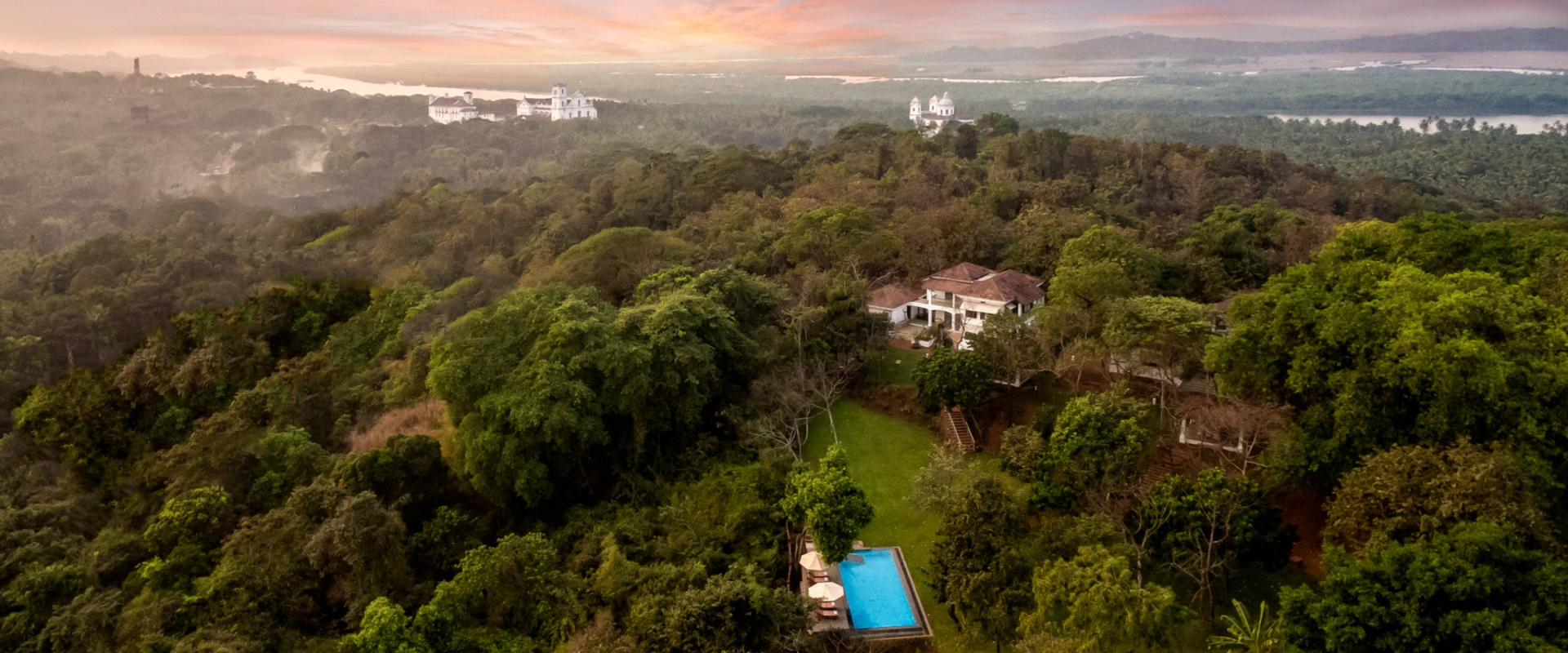
The Postcard Saligao, North Goa offers the paasai, a hosted afternoon tea in a local home, set in a 16th century village of Indo-Portuguese houses. The guest enters a real household in a real village. The host is not performing; they are sharing a tradition that belongs to the place.
This is the standard to hold any hotel to. If a property claims to offer community experiences, ask: where do they happen? Who leads them? Are guests visiting a living neighbourhood or a set built for visitors?
A SETTING THAT IS PART OF A WORKING PLACE
Some hotels are built on cleared land and could be anywhere. Others sit inside landscapes that have their own purpose and history. A tea estate, a farming village, a working plantation: these are places with rhythms that exist whether or not a guest is watching.
The Postcard in the Durrung Tea Estate occupies 1,400 acres of tea plantation in Assam. The estate dates to 1864, according to chota-tingrai.com. A guest staying there is surrounded by a working agricultural landscape, not a garden designed to look like one.
The Postcard Cuelim, South Goa sits on a Portuguese era estate with a 350 year old chapel and views over paddy fields. The property is shaped by centuries of use, not by a design brief written last year.
When considering a hotel, look at what surrounds it. A working estate or a village with its own life gives a stay a texture that landscaping alone cannot.
ARCHITECTURE AND HISTORY THAT BELONG TO THE PLACE
A building tells you whether a hotel was designed for its location or dropped into it. Vernacular architecture, local materials and period structures all signal that the property has roots in its surroundings.
The 16th century village around The Postcard Saligao, North Goa, the Indo-Portuguese houses, the chapel at The Postcard Cuelim, South Goa, the colonial era plantation buildings at The Postcard in the Durrung Tea Estate: each of these structures carries the history of its region in its walls. They were not built to impress a guest. They were built for the life of the place, and the hotel has chosen to preserve and inhabit them.
Look for buildings that have a story older than the hotel itself. If the architecture could belong to any city in the world, the local experience is likely to be shallow.
A PACE THAT LEAVES TIME TO NOTICE EVERYDAY LIFE
Authentic contact with a place requires time. A schedule packed with transfers and activities can move a guest through a region without ever letting them see it. The strongest local experiences often happen in unstructured hours: a morning watching a fishing boat return, an afternoon sitting in a village square, a walk with no fixed destination.
Hotels that understand this tend to build flexibility into the stay rather than filling every hour. The Postcard Hotel collection offers anytime check-in and check-out, subject to availability, confirmed at booking, at no additional charge. That flexibility is not a perk; it is a design choice that respects the guest's own rhythm and, by extension, the rhythm of the place.
When choosing a hotel, consider whether the structure of the stay allows you to slow down. A place that insists on rigid schedules may not leave room for the unplanned encounters that make travel feel real.
QUESTIONS TO ASK A HOTEL BEFORE BOOKING
The simplest way to judge a hotel's claim to local experiences is to ask direct questions before you book. Four are enough to reveal a great deal.
First, who cooks the food? A hotel that can describe its cooks' traditions and training is more likely to serve genuine regional cuisine than one that offers a generic menu.
Second, where do the ingredients come from? Local sourcing is not a slogan; it is a supply chain. Hotels that grow their own produce or buy from named local sources are making a verifiable commitment.
Third, what can guests do beyond the property? If the answer is limited to a spa and a pool, the hotel may be comfortable but not connected to its surroundings.
Fourth, who is involved in those experiences? If local people host, guide or cook, the experience is more likely to be genuine. If everything is managed by hotel staff alone, the local element may be cosmetic.
These questions work for any hotel, anywhere in India. The answers will tell you more than any marketing photograph.
Finding a luxury hotel in India that offers authentic local experiences is not about finding the most expensive room or the longest list of amenities. It is about finding a place where the food, the building, the landscape and the people around it are all part of the same story, and where the hotel opens the door to that story rather than replacing it with one of its own.